
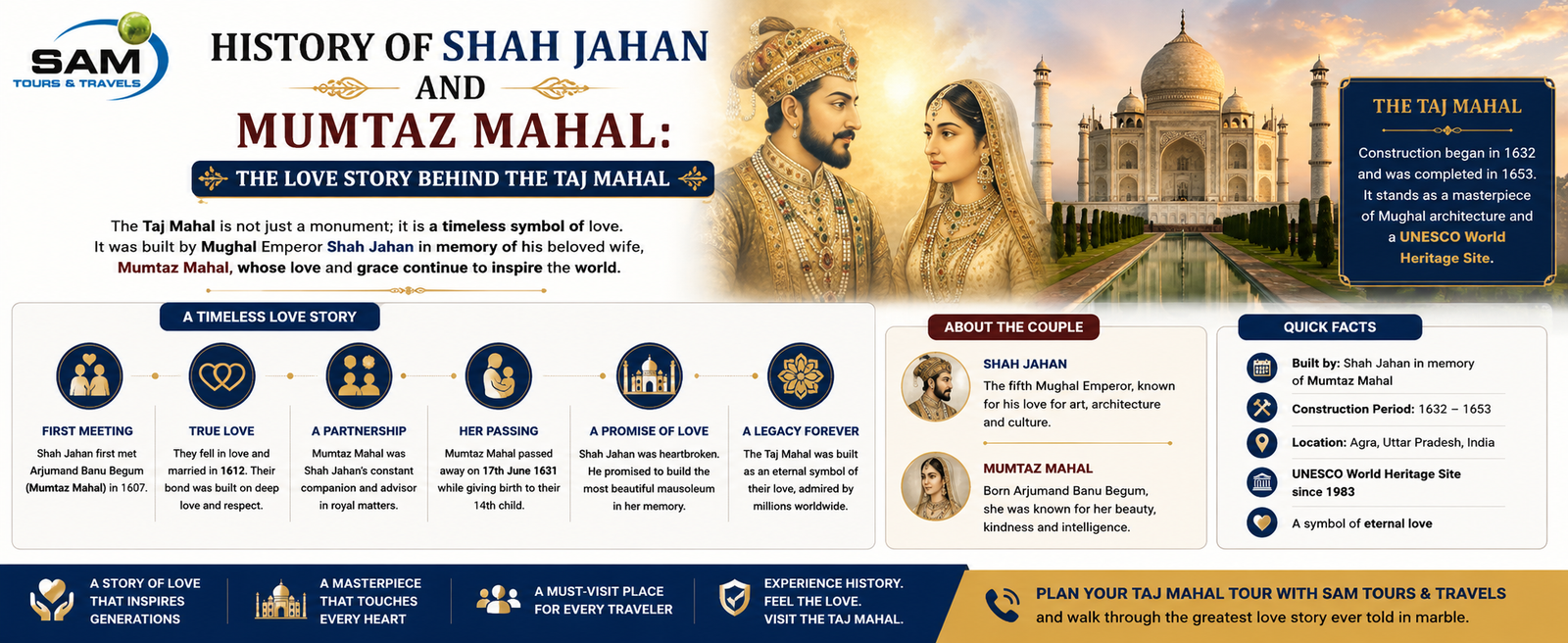
The Taj Mahal is known around the world as a symbol of eternal love. Every year, millions of visitors travel to Agra to admire its beauty and learn about the remarkable story behind its construction. At the heart of this story are Shah Jahan and Mumtaz Mahal, one of the most famous royal couples in history.
Their relationship has inspired countless books, films, and historical studies. While many people know that the Taj Mahal was built in memory of Mumtaz Mahal, few understand the full story of their lives, their marriage, and the events that led to the creation of this architectural masterpiece.
Let’s explore the fascinating history of Shah Jahan and Mumtaz Mahal.
Who Was Shah Jahan?
Shah Jahan was the fifth emperor of the Mughal Empire and one of the most powerful rulers in Indian history.
He was born on January 5, 1592, in Lahore and was originally named Prince Khurram.
He was the son of Emperor Jahangir and belonged to the prestigious Mughal dynasty that ruled large parts of the Indian subcontinent.
From a young age, Prince Khurram showed remarkable leadership skills and military talent, which helped him gain recognition within the royal court.
Who Was Mumtaz Mahal?
Mumtaz Mahal was born as Arjumand Banu Begum in 1593.
She belonged to a noble Persian family that held an important position within the Mughal court.
Known for her intelligence, kindness, and beauty, she quickly became one of the most admired women in the empire.
Although she was born into a privileged family, her influence extended far beyond royal status. Historical records suggest that she played an important advisory role in Shah Jahan’s life.
How Shah Jahan and Mumtaz Mahal Met
The story of Shah Jahan and Mumtaz Mahal began when Prince Khurram first saw Arjumand Banu Begum at the Mughal court.
According to historical accounts, he was deeply impressed by her beauty and personality.
Their meeting marked the beginning of one of history’s most celebrated love stories.
Although they became engaged shortly afterward, royal customs required them to wait several years before marriage.
The Royal Wedding
In 1612, Prince Khurram married Arjumand Banu Begum.
After their marriage, she received the title Mumtaz Mahal, which means “Chosen One of the Palace.”
Their marriage was based on deep affection and mutual respect.
Unlike many royal marriages of the time, historians believe that Shah Jahan genuinely loved Mumtaz Mahal and valued her companionship.
She soon became his closest confidante and most trusted advisor.
A Strong Partnership
Mumtaz Mahal accompanied Shah Jahan on many journeys and military campaigns.
She was not simply an empress living within palace walls.
Historical accounts indicate that she played an active role in the emperor’s life and often traveled with him throughout the empire.
Her advice was highly respected, and Shah Jahan frequently consulted her on important matters.
This close partnership strengthened their relationship and made Mumtaz Mahal one of the most influential women in Mughal history.
Family Life
Shah Jahan and Mumtaz Mahal had a large family.
Together they had 14 children, including several who would later play important roles in Mughal politics.
Among their children was Aurangzeb, who eventually became one of the most powerful Mughal emperors.
Despite the responsibilities of ruling an empire, Shah Jahan remained deeply devoted to Mumtaz Mahal throughout their marriage.
The Tragic Death of Mumtaz Mahal
In 1631, tragedy struck the royal family.
Mumtaz Mahal died while giving birth to her fourteenth child in Burhanpur.
She was only 38 years old.
Her death devastated Shah Jahan.
Historical records describe the emperor as heartbroken and overwhelmed with grief.
For months after her death, he reportedly withdrew from public life and struggled to recover from the loss of his beloved wife.
The Inspiration Behind the Taj Mahal
To honor Mumtaz Mahal’s memory, Shah Jahan decided to build a monument unlike anything the world had ever seen.
His vision was to create a mausoleum that would reflect the depth of his love and preserve her memory forever.
The result was the Taj Mahal.
Construction began in 1632, shortly after Mumtaz Mahal’s death.
The project brought together architects, artisans, craftsmen, and laborers from across Asia.
Building the Taj Mahal
The construction of the Taj Mahal took more than 20 years.
Thousands of workers participated in the project.
Materials were sourced from different regions, including:
- Marble from Rajasthan
- Jade from China
- Turquoise from Tibet
- Lapis Lazuli from Afghanistan
- Sapphire from Sri Lanka
The monument combined Persian, Islamic, and Indian architectural influences, creating one of the greatest masterpieces in world history.
Why the Taj Mahal Became a Symbol of Love
The Taj Mahal is much more than a beautiful building.
It represents:
- Devotion
- Loyalty
- Remembrance
- Eternal love
Because it was built in memory of Mumtaz Mahal, the monument has become a global symbol of love and commitment.
Couples from around the world visit the Taj Mahal to celebrate their relationships and admire its romantic history.
Shah Jahan’s Final Years
Although Shah Jahan built one of the most magnificent monuments in history, his later years were marked by political turmoil.
His son Aurangzeb seized power and placed him under house arrest in Agra Fort.
From his quarters in the fort, Shah Jahan could see the Taj Mahal in the distance.
Historical accounts suggest that he spent his final years gazing toward the monument built in memory of Mumtaz Mahal.
He died in 1666 at the age of 74.
Shah Jahan and Mumtaz Mahal Reunited
After Shah Jahan’s death, he was buried beside Mumtaz Mahal inside the Taj Mahal.
Today, their tombs remain at the center of the monument.
Although centuries have passed, visitors continue to view the Taj Mahal as a tribute to their enduring love story.
Legacy of Shah Jahan and Mumtaz Mahal
The story of Shah Jahan and Mumtaz Mahal continues to inspire people around the world.
Their legacy lives on through:
- The Taj Mahal
- Mughal architecture
- Historical literature
- Cultural heritage
Their story remains one of the most famous love stories in human history.
Conclusion
The history of Shah Jahan and Mumtaz Mahal is a remarkable tale of love, devotion, and remembrance. Their relationship inspired the construction of the Taj Mahal, a monument that has become one of the most recognizable symbols of love in the world. More than three centuries later, visitors continue to admire not only the beauty of the Taj Mahal but also the extraordinary story behind its creation.