
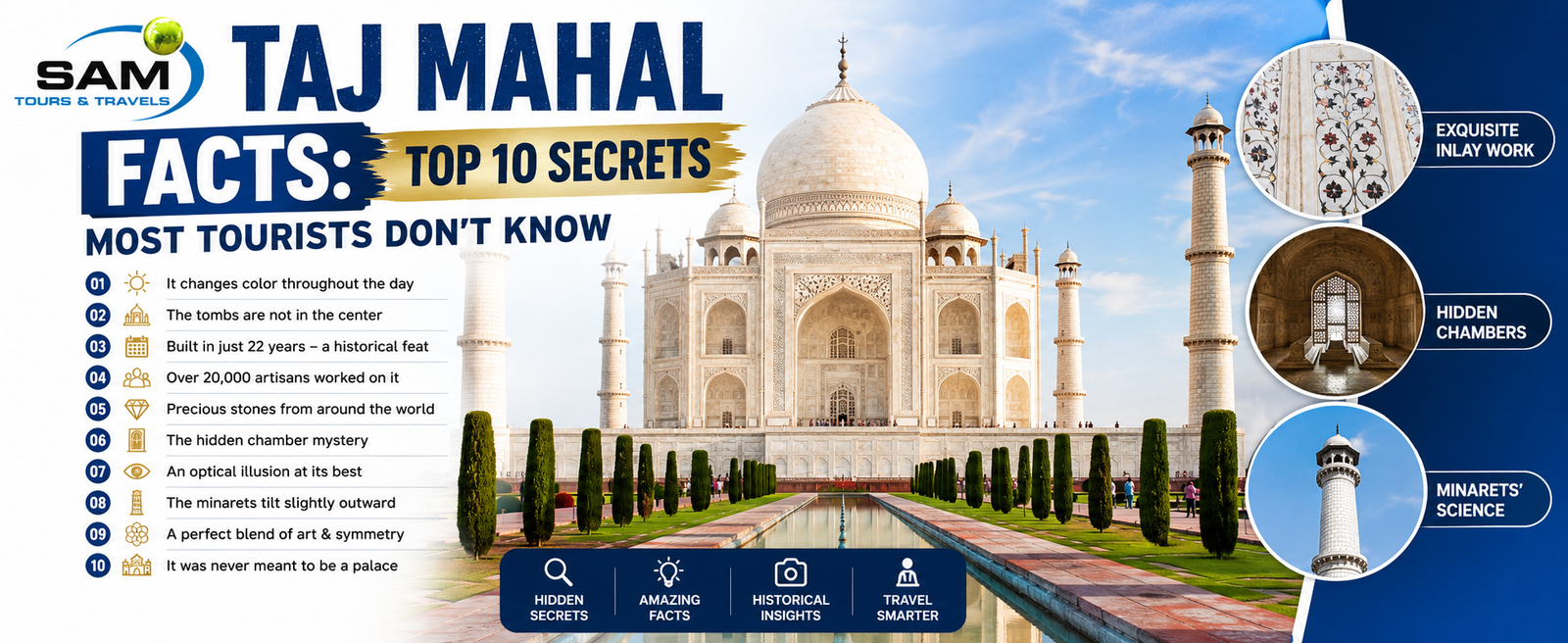
The Taj Mahal is one of the most visited monuments in the world. Located in Agra, India, this magnificent white marble masterpiece attracts millions of tourists every year. Most visitors know that Emperor Shah Jahan built the Taj Mahal in memory of his beloved wife Mumtaz Mahal. However, there is much more to this iconic monument than its famous love story.
From hidden architectural secrets to fascinating historical details, the Taj Mahal continues to amaze travelers centuries after its construction. In fact, many visitors leave without discovering some of the monument’s most interesting facts.
If you’re planning a trip to Agra or simply love history, these Taj Mahal facts will give you a deeper appreciation of one of the world’s greatest architectural wonders.
1. The Taj Mahal Changes Color Throughout the Day
One of the most fascinating Taj Mahal facts is that the monument appears to change color throughout the day.
At sunrise, the marble often looks pink. During the afternoon, it appears bright white. As the sun sets, golden and orange shades begin to appear on the surface. On full moon nights, the monument can even look silver.
This happens because the white marble reflects sunlight differently depending on the weather and time of day.
2. It Took More Than 20 Years to Complete
Construction of the Taj Mahal began in 1632 and was completed around 1653.
More than 20,000 workers, craftsmen, and artisans contributed to the project. The construction involved architects, stone carvers, calligraphers, and laborers from different parts of Asia.
Even today, the Taj Mahal remains one of the most impressive construction projects in history.
3. Precious Stones Decorate the Marble Walls
Many people believe the Taj Mahal is made only of white marble. However, its beauty comes from much more than marble alone.
The walls are decorated with precious and semi-precious stones, including:
- Jade
- Turquoise
- Crystal
- Lapis Lazuli
- Carnelian
- Sapphire
These stones were carefully embedded into the marble using a technique known as pietra dura.
4. The Taj Mahal Is Almost Perfectly Symmetrical
Symmetry is one of the monument’s most impressive features.
Nearly every structure inside the complex mirrors the opposite side. The gardens, pathways, fountains, and buildings were carefully designed to create perfect balance.
Interestingly, there is only one exception. Shah Jahan’s tomb was added later beside Mumtaz Mahal’s tomb, slightly disrupting the original symmetry.
5. The Minarets Lean Slightly Outward
Most visitors never notice this detail.
The four minarets surrounding the Taj Mahal are designed to lean slightly outward rather than standing perfectly straight.
Architects intentionally used this design to protect the main mausoleum. In the event of an earthquake, the minarets would fall away from the monument instead of collapsing onto it.
This clever engineering demonstrates the advanced knowledge of Mughal builders.
6. The Real Graves Are Hidden Below
Inside the main chamber, visitors see beautifully decorated tombs of Shah Jahan and Mumtaz Mahal.
However, these are not the actual graves.
The visible tombs are decorative cenotaphs. The real graves are located in a lower chamber directly beneath them and are not usually accessible to the public.
Many tourists are surprised to learn this fact during their visit.
7. Materials Came From Different Countries
The Taj Mahal was truly an international project.
Materials used in its construction were sourced from various regions across Asia.
For example:
- Marble came from Rajasthan.
- Turquoise came from Tibet.
- Jade came from China.
- Lapis Lazuli came from Afghanistan.
- Sapphire came from Sri Lanka.
This combination of materials contributed to the monument’s extraordinary appearance.
8. The Taj Mahal Is a UNESCO World Heritage Site
In 1983, UNESCO recognized the Taj Mahal as a World Heritage Site.
The organization described it as one of the greatest masterpieces of human creativity.
Today, it is considered one of the most important cultural landmarks in the world and remains India’s most famous tourist attraction.
9. Millions of Tourists Visit Every Year
The Taj Mahal is one of the most visited monuments on the planet.
Every year, millions of domestic and international travelers visit Agra to experience its beauty firsthand.
Because of its popularity, early morning visits are often recommended to avoid large crowds and enjoy a more peaceful atmosphere.
10. It Is the Ultimate Symbol of Love
The most famous Taj Mahal fact is also the most emotional.
After Mumtaz Mahal passed away in 1631, Emperor Shah Jahan decided to build a monument that would honor her memory forever.
The result was the Taj Mahal, a structure that has become a global symbol of love, devotion, and remembrance.
More than 350 years later, people from around the world continue to visit this incredible monument and admire its timeless beauty.
Why the Taj Mahal Continues to Fascinate Visitors
The Taj Mahal is much more than a historical building. It combines art, architecture, engineering, and emotion in a way that few monuments can match.
Whether you’re interested in history, photography, architecture, or culture, the monument offers something unique for every visitor.
Its beauty changes throughout the day, its story touches millions of hearts, and its design continues to inspire architects around the world.
Best Time to Visit the Taj Mahal
The ideal time to visit the Taj Mahal is between October and March.
During these months:
- Temperatures are pleasant.
- Visibility is better.
- Sightseeing becomes more comfortable.
- Photography conditions improve.
Many travelers prefer visiting at sunrise because the monument looks especially beautiful in the soft morning light.
Travel Tips for First-Time Visitors
To make the most of your visit:
- Arrive early in the morning.
- Book tickets online in advance.
- Carry a valid photo ID.
- Wear comfortable walking shoes.
- Bring water during warmer months.
- Consider hiring a local guide.
These simple tips can help you enjoy a smoother and more memorable experience.
Conclusion
These fascinating Taj Mahal facts reveal why the monument remains one of the world’s greatest attractions. From hidden graves and imported gemstones to color-changing marble and advanced engineering, every corner of the Taj Mahal tells a remarkable story.
The next time you visit Agra, take a closer look at the details around you. You may discover that the Taj Mahal is even more extraordinary than you imagined.
.